An in-depth case study of the Colonial Pipeline ransomware attack, exploring how a single compromised password triggered fuel shortages, panic b...
blog
How one forgotten password shut down half the East Coast.
Colonial Pipeline didn’t fall to a zero-day exploit, a nation-state cyber weapon, or some impossibly sophisticated hack.
It fell to a password.
In May 2021, a single compromised credential was enough to bring down the largest fuel pipeline in the United States, disrupt daily life for millions of people, and force the federal government to declare a state of emergency. The incident became one of the most important cybersecurity case studies of the decade — not because it was complex, but because it wasn’t.
This wasn’t a failure of technology. It was a failure of basic cyber hygiene.
Table of Contents
The Pipeline That Keeps the East Coast Moving
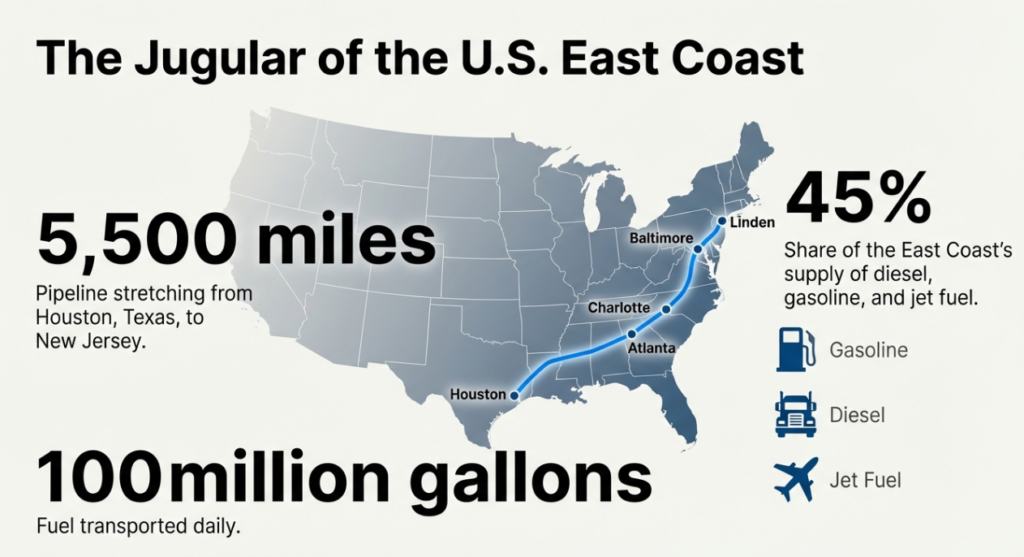
Colonial Pipeline is a 5,500-mile network stretching from Texas to New York, transporting roughly 2.5 million barrels of fuel per day. Diesel. Petrol. Jet fuel. The kind of infrastructure that modern life quietly depends on until it stops working.
Behind the scenes, Colonial relied heavily on digital systems — sensors, automated controls, and IT infrastructure that coordinated billing, logistics, and operations. Like most critical infrastructure operators, efficiency and uptime were prioritised long before cybersecurity became a board-level concern.
That digital dependence is what turned Colonial Pipeline into the jugular of the U.S. East Coast — and what made it such a valuable target.
The Colonial Pipeline is the jugular of the U.S. East Coast
The Breach: One Door Left Open
The attack was carried out by DarkSide, a ransomware group operating under a “ransomware-as-a-service” model. They didn’t need to breach operational technology directly. They didn’t need insider access.
They logged in.
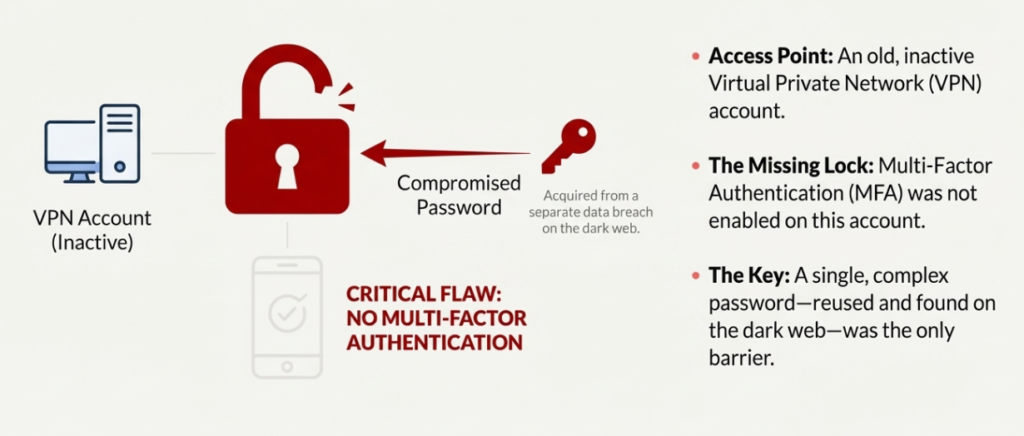
DarkSide gained entry through an inactive VPN account on Colonial Pipeline’s network. The password had likely been exposed in a previous data breach and reused. Crucially, the account did not have multi-factor authentication enabled.
That was it.
No alarms. No sophisticated intrusion techniques. Just a valid username and password on a system no one had properly shut down.
Once inside, the attackers deployed ransomware, encrypting systems and exfiltrating nearly 100GB of data. The infection hit Colonial’s business network — not the pipeline controls themselves — but the damage was already done.
How DarkSide gained access
Why Billing Systems Took Down the Pipeline
At first glance, the decision to shut down the entire pipeline seemed extreme. The pumping systems were still operational. Fuel could technically still flow.
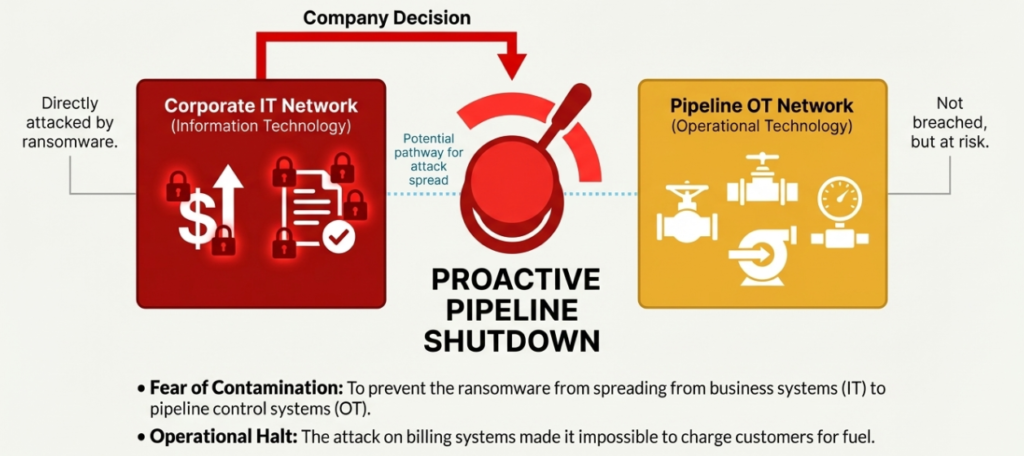
But Colonial faced a brutal reality: without access to billing systems, they couldn’t legally charge customers. More importantly, they could not guarantee that the ransomware wouldn’t spread from IT into operational technology — the systems that physically control fuel flow.
Faced with the risk of losing visibility or control over critical infrastructure, Colonial Pipeline chose containment over continuity. They severed connections between IT and OT environments and proactively shut everything down.
It was a digital firebreak. And it worked — but at a massive cost.
A Nation in Panic: Shortages and States of Emergency
The shutdown lasted six days. The consequences were immediate.
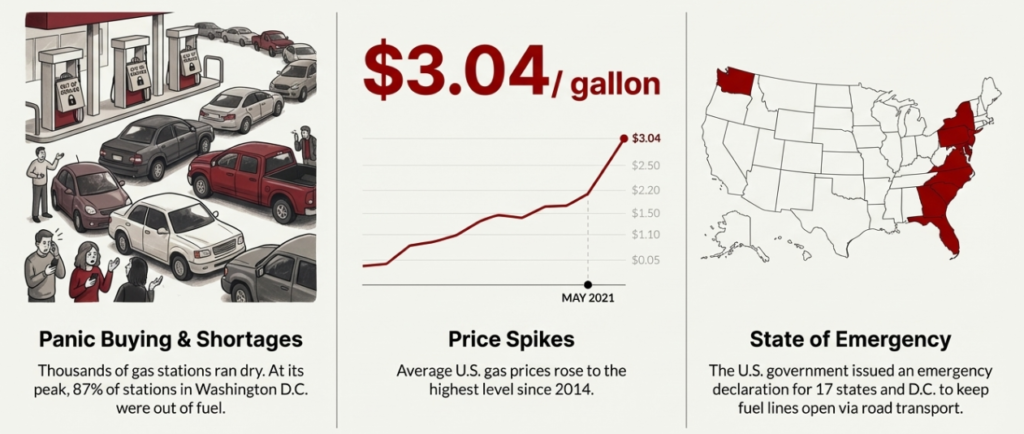
Fuel shortages rippled across the Southeast. Panic buying set in. Stations ran dry not because there was no fuel, but because fear spread faster than supply chains could respond.
By May 11:
71% of fuel stations in Charlotte were out of fuel.
By May 14:
87% of stations in Washington D.C. had run dry.
The situation deteriorated to the point where federal officials publicly warned citizens not to fill plastic bags with gasoline.
The aftermath of the pipeline shutdown: panic buying, price spikes and shortages
President Biden declared a federal state of emergency, temporarily relaxing fuel transport regulations. State governors followed suit. Fuel prices surged past $3 per gallon for the first time since 2014. Airlines, logistics providers, and emergency services all felt the knock-on effects.
All because one account was left unsecured.
Historical Timeline of the Incident
The six-day shutdown and the subsequent recovery efforts unfolded rapidly across the East Coast:
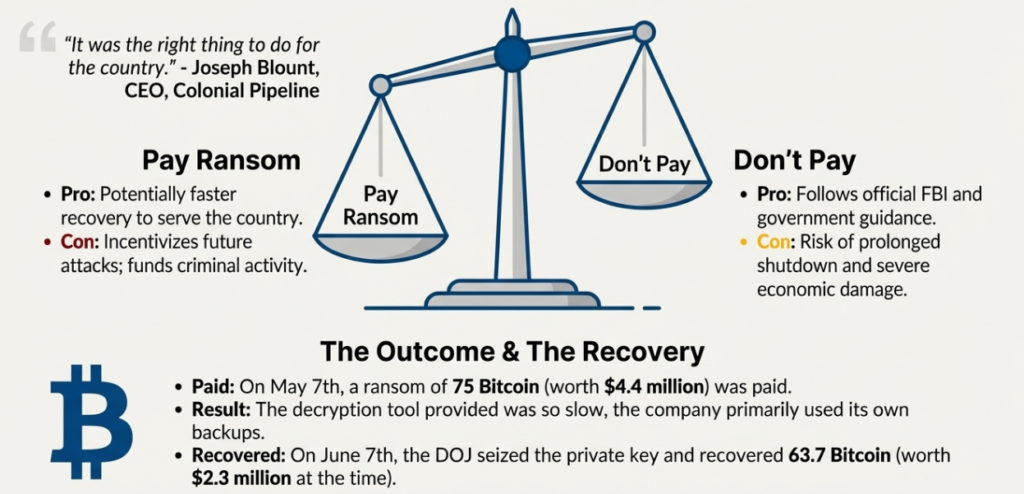
Colonial Pipeline ultimately paid $4.4 million in Bitcoin to DarkSide — a decision that ignited intense debate.
The U.S. government discourages ransom payments for good reason: they fund criminal ecosystems and offer no guarantees. Colonial’s CEO, Joseph Blount, defended the decision, stating that the uncertainty around recovery timelines left them with few alternatives.
In a twist that would be darkly ironic if the stakes weren’t so high, the decryption tool provided by DarkSide was painfully slow and largely ineffective. Colonial’s teams relied primarily on their own backups and recovery processes to restore operations.
In a rare postscript, U.S. law enforcement managed to recover approximately $2.3 million of the ransom a month later by tracing the Bitcoin transaction to a wallet controlled by DarkSide. The recovery was the result of a targeted federal operation — not a standard outcome, and not one organization should expect.
What the Colonial Pipeline Attack Really Taught Us
This incident wasn’t a warning shot. It was a diagnosis.
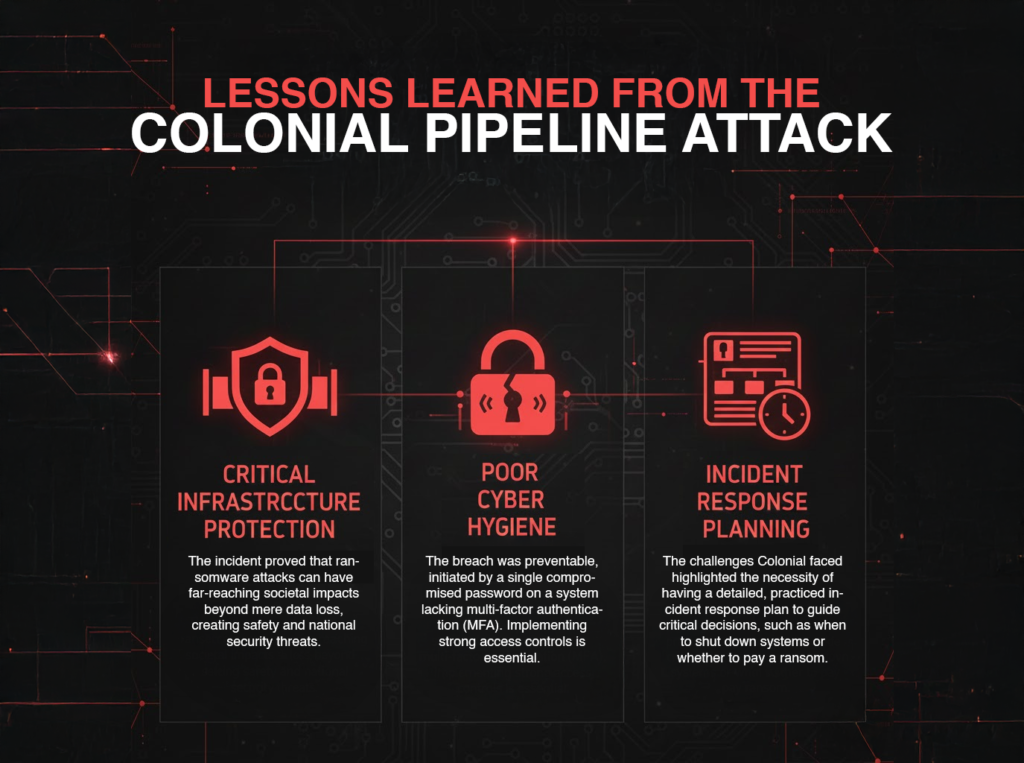
1. Critical Infrastructure Is Only as Secure as Its Weakest Account
Ransomware doesn’t need to target control systems directly to cause national disruption. Business networks, forgotten accounts, and poorly enforced access controls are enough.
2. Cybersecurity Failures Scale Into Societal Crises
This wasn’t just a corporate incident. It affected fuel prices, emergency services, airlines, and public behaviour. Cyber incidents no longer stay inside the organisation.
3. “Basic” Controls Are Still Being Ignored
Multi-factor authentication. Account lifecycle management. Credential hygiene. These are not advanced defences — and yet their absence caused one of the most disruptive cyber incidents in U.S. history.
4. Incident Response Can’t Be Written During the Incident
Colonial Pipeline made difficult decisions under extreme pressure. Organisations that haven’t rehearsed these moments will make worse ones.
The most uncomfortable lesson is also the most important: this attack was preventable.
Why This Still Matters
Most organisations reading this have:
Unused accounts with excessive access
VPNs configured years ago and never revisited
Employees reusing passwords across systems
Colonial Pipeline wasn’t reckless. It was typical.
And that’s the problem.
How to Change Behavior?
The Colonial Pipeline attack didn’t succeed because of bad tools — it succeeded because of everyday decisions, forgotten accounts, and human blind spots. At Aware Force, we specialise in addressing the human and behavioural weaknesses that technology alone can’t fix.
Organisations don’t need more security software. They need stronger cyber awareness, better habits, and a culture that treats cybersecurity as a shared responsibility.
If you want to understand where your organisation’s weakest links really are — before an attacker does — get in touch with Aware Force. We help teams turn awareness into action, and action into resilience.
Because the next national crisis won’t start with a hack. It will start with a login.
Get the latest insights in cybersecurity. Subscribe to the Aware Force Cyber Blog
Insightful cyber news, fresh ideas for engaging your employees and more.
Search
Richard Warner is a recognized expert on human cyber risk and the founder/CEO of Aware Force, where he and his team create cybersecurity content tailored to each client’s culture that is engaging, relatable, and effective.
Leveraging his decades of experience as a prominent journalist and communicator with outlets including FOX and the GPB Television Network, Richard helps organizations worldwide transform human weak links into their strongest digital defense.
He is based in Atlanta and pioneers effective strategies for security culture and employee engagement.